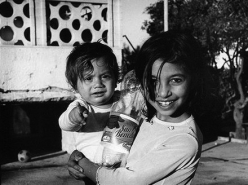
Giovanni Princigalli is an Italian and Canadian citizen. He studied Political Sciences, Sociology, History, and Anthropology at the University of Bari (master thesis with the sociologist Franco Cassano about nomadism, travel and emigration); screenwriting with Giuseppe Piccioni and Umberto Contarello; documentary with C.A. Pinelli (assistant of Federico Fellini) and Annie Comolli (collaborator of Jean Rouch). In 2006 he obtained a Master in Cinema in Montreal. After that he was a movie editor for Italo-Canadian filmmakers Paul Tana and Bruno Ramirez.
He is teacher of cinema at SAC of University of Montreal. His documentaries have been aired by RAI International; Canal Vox ; Tv5 Afrique; Planete Italia ; Repubblica TV and reviewed in the books: Storia del documentario italiano by Marco Bertozzi; Il film etnografico in Italia by Francesco Marano; Seeing Cities Change: Local Culture and Class by Jerome Krase, and by the magazines: Séquences Cinéma (Canada); Sentieri Selvaggi (Italia) ; Canadian Film Studies; Visual Anthropology (USA), Italian American Review, Panorama Cinéma (Canada), etc.
In 2007 he funded his company “Heros fragiles” and worked in Africa, Cuba, the Italian community in Canada and in the gipsy community in Italy. In 2012 he was a member of the international jury at the festival Vues d’Afrique of Montreal.
He grew up in a family that was both modest and militant. His father was a Socialist Party official and an elected member of the Puglia regional assembly (of which he was one of the founders). He was also a member of the national leadership of the League of Cooperatives and one of the founders of the Italian Association for Peace, taking part in missions to Palestine and Jordan and organizing committees and demonstrations against the war in Vietnam and the colonels’ dictatorship in Greece.
Giovanni Princigalli’s aunt, Anna Maria Princigalli, served as an officer in the partisan and Garibaldian Val Grande Martire brigade. Incarcerated by the Fascists, she suffered torture and humiliation. At the end of the war, she was assistant to Piaget and Henri Wallon, and ran schools for former partisans and war orphans.
Family members include journalist Ada Princigalli (first woman foreign correspondent in Beijing in 1970, where she lived for seven years) and A.M. Princigalli, a law professor and jurist. His articles have also been published abroad.